
Lone Star Tick: Identification, Range, Bites, and Alpha-Gal Link
Short answer: The lone star tick is Amblyomma americanum, a CDC-described aggressive human-biting tick. Adult females have a single white dot on the back. The CDC reports it is widely distributed in the Northeast, South, and Midwest, and links it to ehrlichiosis, Heartland virus, Bourbon virus, tularemia, STARI, and the U.S. tick most often associated with alpha-gal syndrome.
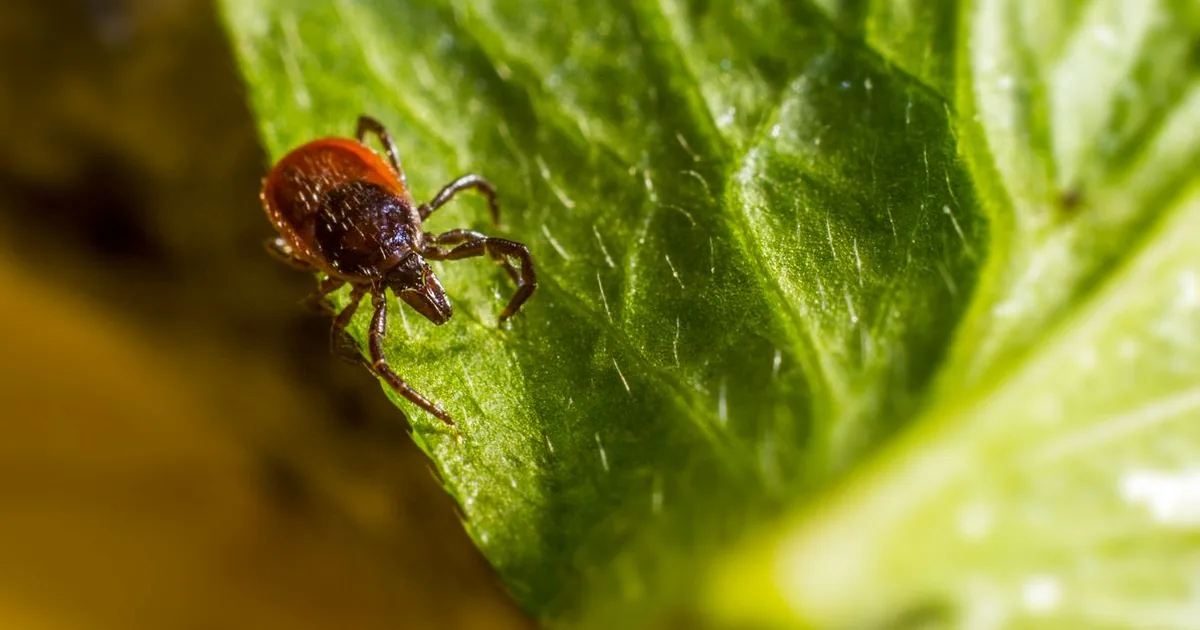
How do you identify a lone star tick?
The adult female is the easy one. The CDC notes she is distinguished by a white dot, the namesake "lone star," on her back. The Illinois Department of Public Health describes adult lone star ticks as about 1/8 inch long and brown, with the female's white spot sitting in the middle of her back.
The younger stages are much harder to see. Per the Illinois Department of Public Health, a larva is only a little larger than the period at the end of a sentence, and a nymph, the most common stage found on people, is about the size of a pinhead.
That small size causes real confusion. The Illinois Department of Public Health notes that lone star ticks are sometimes misidentified as blacklegged ticks, better known as deer ticks, because the two are so similar in size. If you saved the specimen and want to know what bit you, our guide to tick identification walks through the lookalikes.
Where do lone star ticks live?
The CDC reports the lone star tick widely distributed in the Northeast, South, and Midwest United States. The University of Rhode Island's TickEncounter program points to a 2014 study that found lone star ticks as far west as Colorado and Wyoming and as far north as Maine.
In the South, this is the tick that finds you. TickEncounter reports that lone star ticks are the main human-biting ticks in the southeastern and south-central United States, accounting for over 90 percent of reported tick bites in the south.
Up close, they favor cover. TickEncounter describes lone star ticks living mostly in woodlands with dense undergrowth and around animal resting areas.
Their comeback story runs through deer. The CDC calls white-tailed deer a keystone host for this tick. Since the 1940s, conservation measures and deer relocation have increased white-tailed deer numbers and range in the eastern United States, and as the deer rebounded, the lone star tick repopulated its historical range.
How does a lone star tick get on you?
Not by flying or jumping. The CDC explains that ticks can do neither; instead, many species wait in a posture called questing, gripping leaves and grass with their back pairs of legs while holding the front pair outstretched, ready to climb aboard whatever brushes past. TickEncounter notes adult lone star ticks quest for larger animals, humans included, on tall grass in shade or at the tips of low branches.
Per the CDC, most ticks move through four life stages: egg, six-legged larva, eight-legged nymph, and adult. After hatching, they must eat blood at every stage to survive. Lone star ticks aggressively bite people as larvae, nymphs, and adults, and the nymphs and adult females are the stages that most frequently bite humans and transmit disease.
The mechanics matter. The CDC explains that ticks usually acquire pathogens as larvae or nymphs while feeding on animals, then pass those pathogens to people at later stages. TickEncounter notes that lone star larvae do not carry disease-causing germs, though they still inject allergy-provoking saliva when they bite.
What diseases are linked to the lone star tick?
Per the CDC, the lone star tick transmits Bourbon virus, Ehrlichia chaffeensis and Ehrlichia ewingii (the bacteria behind human ehrlichiosis), Heartland virus, and tularemia. A circular rash of unknown cause, called STARI, sometimes follows its bite.
- Ehrlichiosis. The CDC describes ehrlichiosis as a group of diseases caused by Ehrlichia bacteria, spread to people primarily through bites of infected ticks, including the lone star tick and the blacklegged tick. People with ehrlichiosis often have fever, chills, headache, and muscle aches, and sometimes an upset stomach.
- STARI. The CDC says the cause of southern tick-associated rash illness is not known, but it is specifically associated with lone star tick bites. The rash is a red, expanding lesion around the bite site that usually appears within 7 days and grows to 3 to 12 inches across.
- Heartland virus. It spreads to people through bites of infected ticks, primarily lone star ticks, per the CDC. There is no vaccine to prevent it and no medicine to treat it.
- Bourbon virus. The CDC says Bourbon virus is believed to spread through bites of infected ticks, likely lone star ticks. It was discovered in 2014 and named for Bourbon County, Kansas, where it was first identified.
- Tularemia. A potentially serious illness caused by the bacterium Francisella tularensis. The CDC lists the lone star tick among the U.S. ticks that transmit it, alongside the dog tick and the wood tick.
This is not a rare-event category: the CDC estimates that nearly half a million people are diagnosed and treated for a tickborne disease each year. If you develop a fever, an expanding rash, or other symptoms after a tick bite, talk to a clinician. And if a tick is still attached, our tick removal guide covers the calm, correct way to get it off.
Does the lone star tick cause red meat allergy?
This one deserves the CDC's exact caution. Alpha-gal syndrome (AGS) is a serious, potentially life-threatening allergy that can develop after a tick bite. On causation, the CDC's wording is deliberate: AGS is caused by tick bites, "though more research is needed to understand the role ticks play." In the United States, the lone star tick is the tick most often associated with AGS, with a few cases reported after bites from blacklegged and western blacklegged ticks.
The CDC's press materials carry the same hedge: growing evidence suggests that alpha-gal syndrome may be triggered by the bite of lone star ticks, and possibly other tick species. The geography supports the association. A CDC analysis in MMWR found suspected AGS cases predominantly located in areas where the lone star tick is established or reported, and most reported U.S. cases occur in South, East, and Central states, the same areas where most lone star ticks are found. In a recent study the CDC's press materials cite, the states with the highest rates of positive alpha-gal antibody tests were Arkansas, Virginia, Kentucky, Oklahoma, and Missouri.
More than 110,000 suspected AGS cases were identified between 2010 and 2022, and because cases are not nationally notifiable to the CDC, the true number is unknown; as many as 450,000 people may be affected. Not every person bitten by a lone star tick develops AGS, and the reason some people develop it while others do not is not known. For the full picture, read our explainer on alpha-gal syndrome, and bring any new allergic symptoms after a tick bite to a clinician.
When are lone star ticks active?
The CDC notes tick exposure can occur year-round, but ticks are most active during the warmer months, April through September. TickEncounter puts adult lone star ticks on the move from April to late August, questing for larger animals on shaded tall grass and low branches. For a month-by-month breakdown, see our guide to when tick season peaks.
How do you prevent lone star tick bites?
The CDC's playbook, in the order you would use it:
- Before you go out. The CDC recommends EPA-registered insect repellents containing DEET, picaridin, IR3535, oil of lemon eucalyptus, para-menthane-diol, or 2-undecanone. It also recommends treating clothing and gear with 0.5% permethrin, which stays protective through several washings, or buying permethrin-treated clothing. More on that approach in our guide to permethrin-treated clothing.
- While you are out. The CDC advises avoiding wooded and brushy areas with high grass and leaf litter, and walking in the center of trails.
- When you get home. The CDC notes showering within two hours of coming indoors has been shown to reduce the risk of Lyme disease and may reduce the risk of other tickborne diseases. Then do a full-body tick check with a mirror after any potentially tick-infested area, including your own backyard.
On the repellent step: Longsleeve is an EPA-registered picaridin lotion (EPA Reg. No. 101457-1). It repels mosquitoes and ticks for up to 14 hours, and it is fragrance free, with nine disclosed ingredients.
Frequently asked questions
Is STARI the same as Lyme disease?
No. The CDC says studies show STARI is not caused by the bacteria that cause Lyme disease (Borrelia burgdorferi). Lone star ticks have not been shown to transmit B. burgdorferi, and their saliva has actually been shown to kill Borrelia. The cause of STARI is not known, but it is specifically associated with lone star tick bites.
Does every lone star tick bite cause alpha-gal syndrome?
No. The CDC states that not every person bitten by a lone star tick will develop AGS, and the reason some people develop it while others do not is not known. The CDC's framing is that growing evidence suggests AGS may be triggered by lone star tick bites, and that more research is needed to understand the role ticks play. If you notice new allergic symptoms after a bite, talk to a clinician.
The bite site is red and itchy. Does that mean I am infected?
Not necessarily. The CDC notes lone star tick saliva can be irritating on its own, and redness and discomfort at a bite site does not necessarily indicate an infection. If a fever, an expanding rash, or other symptoms follow, see a clinician.
Can lone star ticks jump or fly?
No. Per the CDC, ticks cannot fly or jump. They wait in a questing posture, holding onto leaves and grass with their back legs and stretching their front legs outward to grab a passing host.
How many people get sick from tick bites each year?
The CDC estimates nearly half a million people are diagnosed and treated for a tickborne disease each year.
More Longsleeve in your Google feed:
Sources
- CDC, Lone Star Tick Surveillance: cdc.gov/ticks/data-research/facts-stats/lone-star-tick-surveillance.html
- CDC, Where Ticks Live: cdc.gov/ticks/about/where-ticks-live.html
- CDC, About Ticks: cdc.gov/ticks/about/index.html
- CDC, Tick Lifecycles: cdc.gov/ticks/about/tick-lifecycles.html
- CDC, Preventing Tick Bites: cdc.gov/ticks/prevention/index.html
- CDC, About Ehrlichiosis: cdc.gov/ehrlichiosis/about/index.html
- CDC, About STARI: cdc.gov/stari/about/index.html
- CDC, About Heartland Virus: cdc.gov/heartland-virus/about/index.html
- CDC, About Bourbon Virus: cdc.gov/bourbon-virus/about/index.html
- CDC, About Tularemia: cdc.gov/tularemia/about/index.html
- CDC, Causes of Tularemia: cdc.gov/tularemia/causes/index.html
- CDC, About Alpha-gal Syndrome: cdc.gov/alpha-gal-syndrome/about/index.html
- CDC, MMWR analysis of suspected alpha-gal syndrome cases: cdc.gov/mmwr/volumes/72/wr/mm7230a2.htm
- CDC, Tick Press Kit: cdc.gov/ticks/communication-resources/press-kit.html
- Illinois Department of Public Health, Common Ticks: dph.illinois.gov/topics-services/environmental-health-protection/structural-pest-control/common-ticks.html
- University of Rhode Island TickEncounter, Lone Star Tick: web.uri.edu/tickencounter/species/lone-star-tick/
Last reviewed 2026-08-16 · every claim on this page is sourced above