
Do Bug Zappers Work on Mosquitoes? What Field Studies Found
No, not for the mosquitoes biting you. In field studies, biting flies were a tiny share of the catch: 31 out of 13,789 insects across one Delaware summer. The Indiana trial that measured biting rates found no reduction. Zappers lure with ultraviolet light. Host-seeking females track carbon dioxide, body odor, and heat.
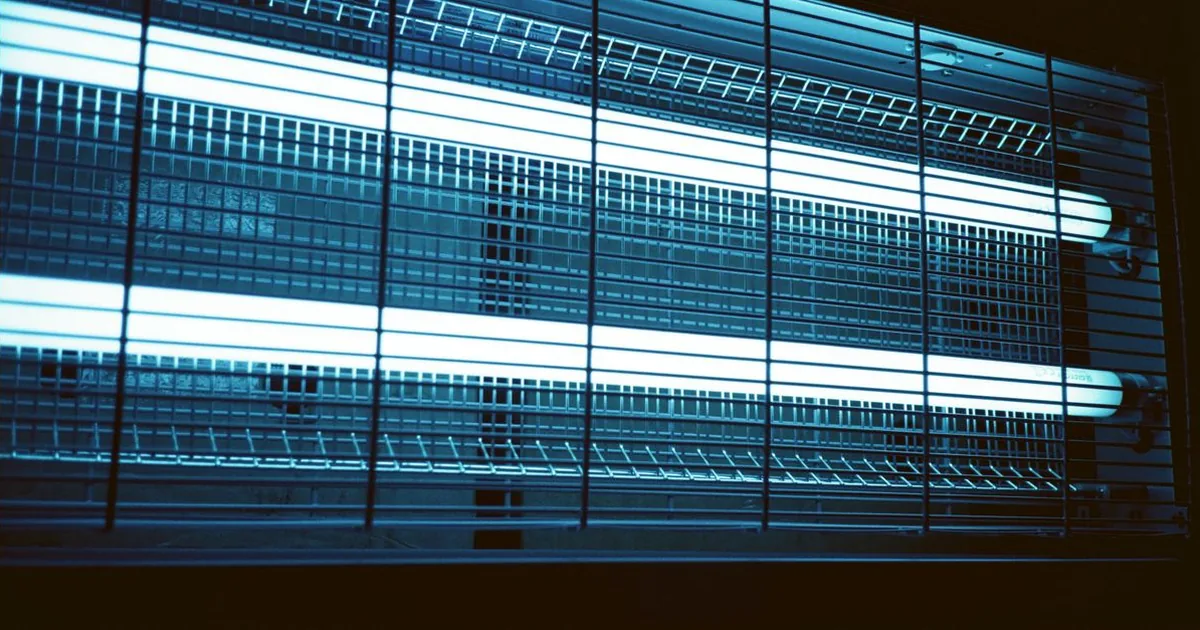
What do bug zappers actually kill?
The fullest count comes from Frick and Tallamy at the University of Delaware. In the summer of 1994 they recruited six homeowners in suburban Newark who already ran zappers, hung a collection dish under each unit, and identified everything that fell in. All six houses sat within 3 km of water, so biting flies had somewhere nearby to breed. The abstract: "Our survey of insects electrocuted during routine use of electric insect traps revealed only 31 biting flies, a minute proportion (0.22%) of the 13,789 total insects counted."
Short answer: Field studies do not support bug zappers as a way to reduce mosquito bites. One Delaware summer count found only 31 biting flies among 13,789 insects killed, and an Indiana biting-rate trial found no reduction. Zappers use ultraviolet light, while host-seeking female mosquitoes track cues such as carbon dioxide, odor, and heat.
Heinen and colleagues, testing retail electrocutors at the University of Michigan Biological Station, found the same shape twice. In 1999, of 8,309 insects killed by the electrocutors, 31 (0.37 percent) were biting insects. In 2002, of 11,076 insects killed across every device they ran, 98 were biting insects. Both years, midges dominated the catch.
Did anyone test whether a zapper reduces bites?
Yes. A low percentage in the tray could still coexist with fewer bites. Nasci, Harris, and Porter ran that test in South Bend, Indiana and published it in Mosquito News in 1983 under a title that gives away the ending: "Failure of an insect electrocuting device to reduce mosquito biting." Six adjacent backyards, eight nights in 1982, two yards with electronic insect killing devices, two with CDC traps, two with nothing. Per the abstract: "Only 3.3% of the 3212 insects killed on an average night were female mosquitoes. Humans in the vicinity of the electrocuting devices were consistently more attractive to mosquitoes than the devices. Even after 11 days of continuous operation, the electrocuting devices failed to reduce the mosquito biting rate."
The American Mosquito Control Association summarizes the yard-level evidence in its FAQ: two controlled studies by independent investigators at the University of Notre Dame found mosquitoes made up "merely 4.1% and 6.4% respectively of the daily catch over an entire season," and in both, "there was no significant difference in the number of mosquitoes found in yards with or without bug zappers."
A 1998 Illinois trial by Jensen and colleagues counted mosquito landing rates against a UV insect-killing grid baited with 1-octen-3-ol and several other consumer products. The abstract names the winners: "the mosquito coils and the deet-impregnated wrist bands did significantly reduce mosquito landing rates relative to untreated controls." The UV grid is not on that list.
Why doesn't ultraviolet light pull in host-seeking mosquitoes?
Because the cues a host-seeking female follows come off a living body. Writing in Cell in 2014, McMeniman and colleagues describe the cue set: "To orient towards hosts, female mosquitoes detect a variety of chemical and physical cues including body odor, CO2, moisture, heat, and visual contrast." Exhaled CO2, they add, "is often considered to be the most important sensory cue used by these disease vectors to find humans." Ultraviolet light is not on that list. More on those cues in why mosquitoes bite some people.
Frick and Tallamy laid out the mechanics. Consumer trap lamps emit a lot of visible light, and lamps like that "are less attractive to mosquitoes than lamps emitting only ultraviolet wavelengths." Beyond that, "many species of mosquitoes are not attracted to light traps at all." They call two reasons perhaps the most important: "carbon dioxide exhaled by homeowners is far more attractive to mosquitoes than are light traps," and "mosquitoes that do move toward traps are rarely killed by electrocution devices." There is a timing problem too. The CDC Yellow Book puts peak biting activity for Aedes aegypti and Aedes albopictus at dawn and dusk, while Culex quinquefasciatus peaks after sunset, "usually between 10 and 11 p.m."
Does adding octenol or carbon dioxide fix it?
Manufacturers tried. Heinen and colleagues tested electrocutors with and without an octenol lure, alongside propane-burning "eliminator" traps that use carbon dioxide, heat, and octenol instead of light. Octenol on a zapper did not help. Their results table records that octenol "did not effect the numbers of biting insects killed by electrocutors" (0.1 > p > 0.05), while "electrocutors baited with octenol killed more non-biting insects than electrocutors not baited with octenol" (p < 0.001). The bait mostly increased the midge and moth kill.
The CO2 traps were far more selective. Of 69 insects taken by eliminators, 19 (27.5 percent) were biting insects, a significantly higher proportion than the electrocutors managed. The total is the problem: 69 against 11,009 for the electrocutors that year. The AMCA's view of baited traps generally: they "will trap and kill measurable numbers of mosquitoes," yet "the homeowner must still use repellents and practice source reduction methods."
What else does a zapper do?
Frick and Tallamy's traps averaged 445 insects per trap on nights they ran at least two hours. The authors then ran an extrapolation they called speculative: if 4 million traps run 40 nights a summer, that is more than 71 billion nontarget insects a year in the United States.
There is also the spray. Urban and Broce, in Current Microbiology in 2000, loaded house flies with bacteria or a phage and electrocuted them in a room: "Sprayed flies released one of every 10,000 of the added bacteria or viruses." Their conclusion kept the qualifier: the results "suggest EITs could play a role in the spread of infectious disease agents, but the potential is influenced by the insect's route of contamination." Colorado State University Extension: zappers "should never be used near areas where food is prepared or consumed."
Why doesn't the EPA make manufacturers prove these work?
Because under federal pesticide law a zapper is a device, not a pesticide. The EPA names the category: "Products claiming to control pests via electromagnetic and/or electrical means (e.g., ultrasonic insect and rodent repellers, hand-held bug zappers, electric flea combs) are devices, provided that ... the product is not sold with a pesticidal substance." And: "For products regulated as devices, there is no required premarket review." Registered pesticide products, by contrast, "undergo a thorough review of data supporting the registration, including product performance (efficacy) studies." Same rule, same reason ultrasonic repellers stay on shelves.
What do university extension services say?
- Penn State Extension: "Avoid bug zappers. While these devices may appear to have value, research has shown that they kill few mosquitoes. They kill many beneficial insect species that can benefit insect control around your home and yard."
- University of Maryland Extension: "Do NOT use bug 'zappers', mosquito traps, or plants marketed as having mosquito repelling properties." (More on repellent plants.)
- Rutgers Center for Vector Biology: "Comparison trapping has also shown no significant difference in mosquito populations in yards with and without the traps."
- Iowa State University Extension on the Delaware data: "Pests, and especially biting pests, do not end up in the traps."
- University of Florida IFAS reported in 1997 that in tests at its Florida Medical Entomology Laboratory, "Out of some 10,000 insects destroyed by one bug zapper during a one-night test period, only eight were mosquitoes."
What does the CDC recommend for mosquito bites?
The CDC recommends EPA-registered insect repellents with one of six active ingredients: DEET, picaridin (known as KBR 3023 and icaridin outside the United States), IR3535, oil of lemon eucalyptus, para-menthane-diol, or 2-undecanone. It adds: "Look for an EPA registration number (EPA Reg. No.) on the insect repellent product label. This registration number means the company provided EPA with technical information on the effectiveness of the product."
Alongside that: loose-fitting long-sleeved shirts and pants, permethrin-treated clothing and gear, window and door screens, air conditioning where available, and once a week emptying and scrubbing anything that holds water, which our guide to standing water control covers. For the yard, the CDC points to larvicides for water that cannot be dumped and outdoor adulticides for the "dark, humid areas" where adults rest.
How solid is this evidence?
Solid on catch composition, thinner on yard-level bite counts, and the authors say so themselves. Frick and Tallamy wrote: "Since we did not independently measure mosquito populations in our study sites we cannot definitively conclude that the zappers used in our study were ineffective mosquito killers." Heinen and colleagues flagged the same gap: "On the evenings sampled, the human collectors were regularly bitten by both mosquitoes and blackflies, suggesting their presence." The mosquitoes were present. They were biting the collectors even as the grids caught almost none.
Most of this work is also old: Delaware 1994, Indiana 1982, Michigan 1999 and 2002. We found no recent peer-reviewed field trial overturning it. If a bite reaction worries you, or you develop a fever or rash after being bitten, talk to a clinician. Our bite treatment guide covers ordinary cases.
Common questions
Do bug zappers attract more mosquitoes into my yard?
We could not verify that with a controlled measurement. The studies we retrieved counted what died in the tray and what bit the people standing nearby, not whether more mosquitoes arrived. They did find the devices failed to reduce biting.
Do zappers work on no-see-ums, black flies, or ticks?
The Delaware study counted 12 female biting midges and one black fly among its 13,789 insects. As for ticks, the CDC says they "can't fly or jump," so a flying-insect light trap has no bearing on them. See when tick season runs and prevention instead.
What about the propane CO2 traps?
More selective than a zapper, but the Michigan eliminators caught only 69 insects in total. The AMCA cautions "against putting too much faith in traps as your sole means of control."
Where Longsleeve fits
Longsleeve is an EPA-registered picaridin lotion (EPA Reg. No. 101457-1). It repels mosquitoes and ticks for up to 14 hours. It is fragrance-free, with nine disclosed ingredients.
More Longsleeve in your Google feed:
Sources
- Frick TB, Tallamy DW. Density and diversity of nontarget insects killed by suburban electric insect traps. Entomological News, 1996;107:77-82. Record: https://www.biodiversitylibrary.org/part/31146. Full text: https://archive.org/details/biostor-76681
- Nasci RS, Harris CW, Porter CK. Failure of an insect electrocuting device to reduce mosquito biting. Mosquito News, 1983;43(2):180-184. https://www.biodiversitylibrary.org/part/131757
- Heinen JT et al. Factors affecting capture rates of insect taxa by retail electrocutors and eliminators in northern lower Michigan. The Great Lakes Entomologist, 2003;36(1-2). https://scholar.valpo.edu/tgle/vol36/iss1/10/
- Jensen T et al. Field efficacy of commercial antimosquito products in Illinois. Journal of the American Mosquito Control Association, 2000;16(2):148-152. https://pubmed.ncbi.nlm.nih.gov/10901639/
- McMeniman CJ, Corfas RA, Matthews BJ, Ritchie SA, Vosshall LB. Multimodal integration of carbon dioxide and other sensory cues drives mosquito attraction to humans. Cell, 2014;156(5):1060-1071. https://www.ncbi.nlm.nih.gov/pmc/articles/PMC4007582/
- Urban JE, Broce A. Killing of flies in electrocuting insect traps releases bacteria and viruses. Current Microbiology, 2000;41(4):267-270. https://pubmed.ncbi.nlm.nih.gov/10977894/
- Iowa State University Extension and Outreach, Yard and Garden. Bug Zappers are Harmful, Not Helpful (June 14, 1996). https://yardandgarden.extension.iastate.edu/article/1996/6-14-1996/bugzapper.html
- Penn State Extension. Got Mosquitoes? Eliminate Mosquitoes with IPM. https://extension.psu.edu/got-mosquitoes-eliminate-mosquitoes-with-ipm
- University of Maryland Extension. Controlling Mosquitoes. https://extension.umd.edu/resource/controlling-mosquitoes
- Colorado State University Extension. Flies in the Home. https://extension.colostate.edu/resource/flies-in-the-home/
- Rutgers Center for Vector Biology. Products and Promotions That Have Limited Value for Mosquito Control. https://vectorbio.rutgers.edu/outreach/proprom.php
- University of Florida IFAS. Electric Bug Zappers Useless For Controlling Mosquitoes (July 23, 1997). https://blogs.ifas.ufl.edu/news/1997/07/23/electric-bug-zappers-useless-for-controlling-mosquitoes/
- American Mosquito Control Association. FAQs. https://www.mosquito.org/faqs/
- EPA. Pesticide Devices: A Guide for Consumers. https://www.epa.gov/pesticides/pesticide-devices-guide-consumers
- CDC. Preventing Mosquito Bites. https://www.cdc.gov/mosquitoes/prevention/index.html
- CDC. Mosquito Control at Home. https://www.cdc.gov/mosquitoes/mosquito-control/mosquito-control-at-home.html
- CDC Yellow Book. Mosquitoes, Ticks, and Other Arthropods. https://www.cdc.gov/yellow-book/hcp/environmental-hazards-risks/mosquitoes-ticks-and-other-arthropods.html
- CDC. About Ticks and Tickborne Disease. https://www.cdc.gov/ticks/about/index.html
- Federal Trade Commission. FTC Warns Manufacturers, Retailers of Ultrasonic Pest-Control Devices (May 2001). https://www.ftc.gov/news-events/news/press-releases/2001/05/ftc-warns-manufacturers-retailers-ultrasonic-pest-control-devices
Last reviewed 2026-08-16 · every claim on this page is sourced above